"AFRICAN GREY PARROT"
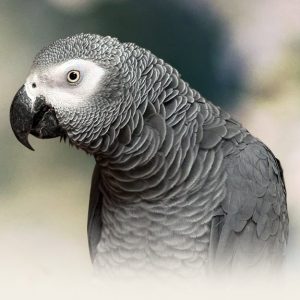
The African dark parrot's capacity to talk and copy sounds makes this medium-sized parrot a dazzling friend. African dark proprietors frequently report that their grays customarily talk in setting and appear to be exceptionally receptive to their kin's feelings. The African dim parrot isn't only a top talker - this bird is likewise known for its outrageous knowledge, which gives them the moniker "The Einsteins of the Bird World."
(i)Shading
Dark
(ii)SIZE
medium
(iii)Life expectancy
30 + years
(iv)SOUNDS
Vocal communicator
(v)Cooperation
Exceptionally friendly

The African dim parrot is one of the most gifted talking/copying birds in the world, giving it truly a standing among bird fans. Not exclusively bird guardians love this savvy bird, it's quite possibly the most unmistakable specie to bird beginners also - everybody knows the African dark parrot. This parrot is one of the most established psitticine species kept by people, with records of the bird tracing all the way back to scriptural occasions. Downplayed excellence and a smart straightforward demeanor keep this parrot at the pinnacle of ubiquity.
From the outset, the African dim is a medium-sized, dusty-looking dim bird, nearly pigeon-like - yet further examination uncovers a radiant red tail, shrewd orange eyes, and a dazzling scalloped example to its plumage.
1-NATIVE REGION / NATURAL HABITAT.
African dim parrots for the most part occupy savannas, beach front mangroves, forest and edges of timberland clearings in their West and Central Africa range. However the bigger of the African dark subspecies is alluded to as the Congo African dim, this bird really has a lot more extensive normal reach in Africa, including the southeastern Ivory Coast, Kenya, and Tanzania. The Timneh African dim is found in a more modest area along the western edge of the Ivory Coast and through southern Guinea. Their eating routine in the wild comprises for the most part of palm nuts, seeds, natural products, and verdant matter.
2-CARE & FEEDING.
There's a motivation behind why the African dark is frequently viewed as the banner bird for parrot insight - not exclusively is this bird leaned to gather a huge jargon, African grays likewise show an inclination for perceiving the importance of words and expressions.
African grays need a lot of toys that challenge their insight, for example, searching and puzzle toys. Nutri-Berries by Lafeber Company are ideally suited for searching. This total food mixes an equilibrium of grains, seeds, and different supplements looking like a berry. Since the grains and seeds are generally entire and framed into a berry shape, it urges African grays to hold, snack, and even play with the Nutri-Berries. This emulates the scavenging that African grays do in nature.
African grays appear to be particularly impacted by pressure and disturbance in their current circumstance and can be reassured more by setting one corner of the enclosure against a divider rather than in a room.
African dim parrots are more inclined to lack in vitamin-A/beta-carotene, and along these lines benefit from eating vegetables high in beta-carotene, like cooked yam and new kale. Vitamin-D inadequacy is another worry, particularly for grays on a horrible eating routine. Offering a reasonable, pelleted diet, like Nutri-Berries, for the fundamental eating routine of an African dim forestalls nutrient and mineral insufficiencies. A dark that devours a pelleted diet for the most part needn't bother with nutrient enhancements added to its food.
3-PERSONALITY & BEHAVIOR.
Most bird managers accept that main an accomplished bird aficionado should keep a dark. They are mind boggling parrots, profoundly delicate, and all around requesting. They are additionally beguiling and splendid, however this match of awareness and cerebrums can prompt social issues. They are predictable animals, and surprisingly a little change in routine can make a delicate dark miserable. They are inclined to culling and biting their plumes, among other unfortunate quirks. Narratively, the TAG has a hardier disposition and might be better for families with a many individuals traveling every which way. The CAG favors somewhat less disarray.
African grays are social parrots that need a ton of involved time, notwithstanding, they aren't "cuddlebugs." They will endure some head scratching and a tad of petting, yet they don't see the value in extraordinary actual contact, however a few people wouldn't fret a little cuddling. Each bird has individual preferences and inclinations. A dim can likewise turn into a "one individual bird," regardless of whether each individual from the family associates with it all along.
4-SPEECH & SOUND.
A large part of the dark's allure comes from its talking capacity. It is among the best talkers in the parrot family, ready to rehash words and expressions in the wake of hearing them only a single time or two times. This bird arrives at full talking capacity around an extended time old enough, and most people become fit mirrors significantly sooner.
Not exclusively will a dim foster a remarkable jargon, research has shown that this species can come to get what it's talking about. The most well known CAG, Alex, and his associate, Dr. Irene Pepperberg, might be the justification for the notoriety of this species, and unquestionably for its prominent. Alex and Dr. Pepperberg cooperated for quite some time at Brandeis University until his appalling passing in 2007, because of a devastating occasion related to arteriosclerosis ("solidifying of the supply routes"). In their thirty years of exploration, Dr. Pepperberg encouraged Alex to perceive and recognize items, shadings, and shapes. Alex could likewise comprehend the ideas of same and unique, class, and could even count objects. However Alex was en route to considerably more perplexing manners of thinking, including how to peruse, his kindred African grays Griffin and Arthur (AKA "Mole") are proceeding to work with Dr. Pepperberg attempting to arrive at the point that Alex had reached and surprisingly further.
In any case, since grays are savvy and may decide to talk instead of shouting, it's a mix-up to accept that they aren't loud. They aren't quite so clearly or constant as a portion of the South American species, however they will learn family sounds and use them indefatigably to the consternation of gatekeepers. Envision the microwave signaling perpetually, or a cellphone ringing frantically without the advantage of switching it off.
5-HEALTH & COMMON CONDITIONS.
African grays are particularly vulnerable to feather picking, calcium inadequacy, vitamin-An and vitamin-D lack, respiratory contamination, psittacosis and psittacine bill and quill infection (PBFD).


No comments:
Post a Comment